Vanguard Research recently published a whitepaper titled Vanguard’s Principles for Retirement Income (direct PDF link) that reads like a concise guide to turning savings into reliable retirement income. Rather than focusing primarily on growing account balances, the paper emphasizes how to convert a portfolio into steady, sustainable spending throughout retirement.
Focusing on income rather than account balances can lead to clearer decision-making in retirement.
Without a defined income plan, investors may spend too cautiously or risk drawing down their assets too quickly. With an income-focused framework, you can better understand how to turn your savings into spending by having a clearer view of:
– How much you can withdraw over time.
– How long your assets may need to last.
– How different risks can affect outcomes.
The paper frames retirement income planning around guaranteed income sources—such as pensions, annuities, and Social Security—and an expected sustainable withdrawal from investment assets. Historical analyses point to a long-run portfolio withdrawal rate in the neighborhood of 3.5% to 4% for many investors, though individual circumstances and market sequences will affect that figure.
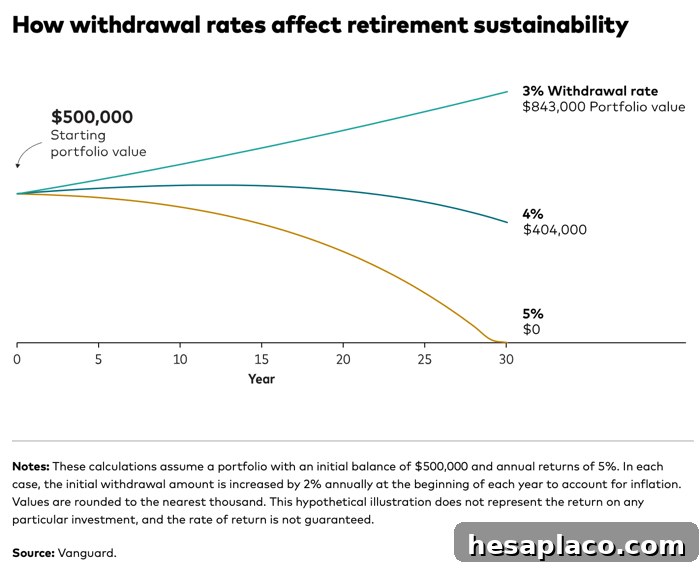
Vanguard recommends a range of strategies to make savings stretch further and to create sufficient lifetime income. Some strategies involve major, lifestyle-level choices; others are adjustments that can improve outcomes incrementally. Key approaches include:
- Work longer. Increasing years in the workforce raises earnings, delays Social Security claiming (which typically increases future benefits), and shortens the period during which savings must provide income—making this one of the most effective ways to improve retirement security.
- Adopt dynamic spending. Instead of using a fixed withdrawal rate, dynamic spending adjusts withdrawals in response to market performance and portfolio health. Reducing withdrawals after poor returns and allowing higher withdrawals after strong returns can extend portfolio longevity. There are several practical rules and glidepaths advisers use to implement dynamic approaches.
- Convert some assets to a single-premium immediate annuity (SPIA). Purchasing a SPIA can create a guaranteed income floor to reliably cover essential expenses. For retirees who prioritize security over liquidity, an SPIA helps manage longevity risk.
- Consider tapping home equity. Home equity can act as a reserve to support living expenses later in retirement. Reverse mortgages or downsizing are tools to access housing wealth, but they require careful evaluation of costs, fees, and implications for heirs and lifestyle.
- Use Roth conversions strategically. Converting tax-deferred accounts to Roth during lower-income years—such as shortly after retiring but before required minimum distributions begin—can reduce lifetime taxes and provide more flexibility for tax-efficient withdrawals in later years.
- Follow a tax-efficient withdrawal order. Withdrawing from accounts in a tax-aware sequence typically improves net income. A common framework is to draw from taxable accounts first, then tax-deferred accounts, and to preserve Roth accounts for last, since Roth distributions are generally tax-free and can provide valuable tax shelter later in retirement.
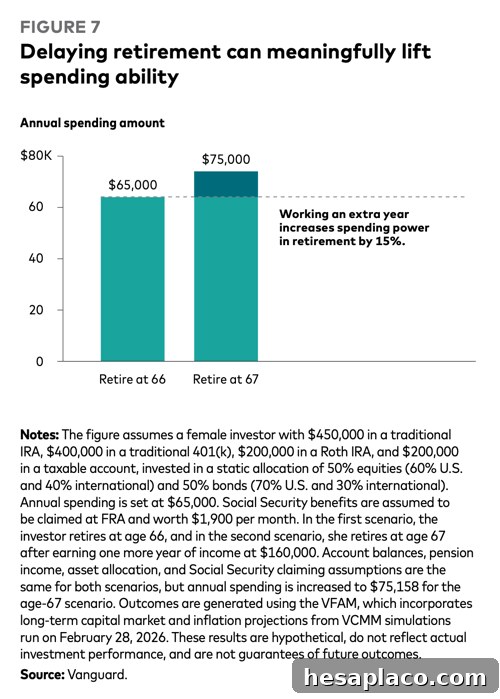
The whitepaper also emphasizes assessing risks that can derail income plans—sequence-of-returns risk, inflation, longevity, and unexpected health or long-term care needs—and aligning portfolio construction and withdrawal policies to those risks. For example, maintaining diversified assets, including a mix of equities and bonds, can support growth while providing income stability, and integrating guaranteed income sources can reduce sensitivity to market shocks.
Vanguard’s guidance encourages retirees and advisers to shift from thinking about account balances to a holistic income plan that specifies how much can be spent, the timeframe assets must cover, and how to respond to changes in markets or personal circumstances. That shift helps clarify trade-offs—such as accepting lower initial spending to preserve longevity of assets, or allocating some capital to annuities to secure essential cash flow.
Overall, the whitepaper provides practical, evidence-based ideas to explore when planning retirement income. Whether you’re seeking incremental improvements or facing difficult choices to prevent running out of money, these strategies offer frameworks and options to build a more durable income plan for retirement.