
For decades, retirement advisers have urged people to start saving early and consistently to secure a comfortable retirement. Only more recently has there been significant attention on how to manage those savings once you stop accumulating wealth and begin living off the proceeds of a lifetime of work.
The modern focus on ensuring you don’t outlive your money began in 1994 when William Bengen introduced the “safe withdrawal rule,” best known as the 4 percent rule.
The 4 Percent Rule

Bengen studied historical returns back to 1926 and concluded that retirees with a portfolio split roughly 50 percent stocks and 50 percent bonds could withdraw 4 percent of the portfolio each year—adjusted for inflation—and likely avoid running out of money over a typical retirement horizon.
The 4 percent rule gained traction because it was simple and easy to apply. The challenge is that the investment environment has changed considerably since 1994, yet many still treat Bengen’s rule as the single solution for retirement planning. Financial advisers note that while the 4 percent rule remains a useful starting point for setting savings targets, applying it effectively now requires greater nuance and flexibility.
How Much Money Do You Need?

When clients ask how much they need to save before retiring, David Chwalek of Senes & Chwalek Financial Advisors in Concord, Massachusetts, gives the short, honest answer: it depends.
It depends.
Everyone’s retirement looks different. Some retirees stay in the same home for decades and spend their time with family, gardening, and casual outings. Others plan for a second home, frequent travel, or more expensive hobbies. The amount you’ll need depends on the lifestyle you envision.
Chwalek says the 4 percent rule is still a helpful framework for thinking about spending rates but should not be used as an inflexible prescription. Several caveats matter: how your portfolio is allocated, how much cash you hold for short-term needs, and how you plan for market volatility and unexpected expenses.
Market Fluctuations Matter
If a retiree immediately begins withdrawing 4 percent while invested aggressively and the stock market plunges early in retirement, their income and portfolio sustainability could be at serious risk. Conversely, retirees who keep a few years’ worth of income in cash or conservative investments are better positioned to ride out short-term downturns without being forced to sell at depressed prices.
Planning Your Retirement Budget

Predicting long-term expenses is difficult. Unlike monthly household bills, which are relatively predictable, healthcare costs and long-term care needs can vary greatly and tend to rise faster than general inflation. It’s also uncertain how much retirees will be able to rely on Social Security, pensions, or other non-investment income streams.
Concerns About Social Security
Social Security may or may not remain a large portion of retirement income depending on future policy and taxation. Pensions are valuable, but if they are not inflation-indexed, their purchasing power will decline over time.
Concerns About Healthcare Costs
Healthcare inflation typically outpaces overall inflation. Retirees should research healthcare costs in the region where they plan to live and build projections for major expenses throughout retirement. Comparing those projected expenses to expected portfolio income on a year-by-year basis helps identify potential shortfalls and the need for adjustments.
Why the 4 Percent Rule May No Longer Work

Advisers point out that the 4 percent rule was developed in a period when bond yields were higher and more stable. Today’s historically low bond yields mean that following a traditional 60/40 portfolio and withdrawing 4 percent could deplete assets faster than Bengen anticipated. Some advisers now recommend a more conservative withdrawal rate—often 2 to 3 percent—unless retirees use additional strategies to protect income.
One such strategy is blending stocks with fixed indexed annuities or other guaranteed income products. These can provide downside protection and steadier income streams, and many advisers incorporate a diversified mix along with systematic withdrawal plans and buffers for severe market declines.
Retirement Risk Factors

Risk Factor #1: Living Too Long
Longevity increases the time horizon for withdrawals, and inflation compounds the problem. For example, a retiree needing $3,000 per month at 65 would need roughly $5,432 per month at 85 assuming 3 percent annual inflation. Without planning for both longevity and inflation, many retirees face significant shortfalls.
This reality argues against overly conservative allocations that replace stocks with bonds and reduce long-term growth potential. Historically, stocks have been the asset class most likely to outpace inflation, so retaining an appropriately diversified stock allocation can help preserve purchasing power over long retirements.
Risk Factor #2: Volatility
Volatility can be measured by a portfolio’s standard deviation from average returns. Higher standard deviation means greater volatility and a higher risk of portfolio failure in retirement. Evaluating and managing volatility—through diversification, allocation adjustments, and risk-managed strategies—can reduce the chance of severe capital erosion.
Risk Factor #3: Sequence of Returns
Sequence of returns risk refers to the danger of experiencing poor market returns early in retirement, which magnifies the impact of withdrawals. Withdrawing from a portfolio after an early downturn forces retirees to sell more assets at depressed prices, compounding the loss. A prudent approach is to maintain a “safe bucket” of cash or conservative assets to draw from during downturns, giving equities time to recover and reducing the need to sell at lows. Safe-bucket assets can include cash, CDs, guaranteed annuities, life insurance cash values, or a reverse mortgage reserve account.
Risk Factor #4: Interest Rates
Bonds and interest rates have an inverse relationship: when interest rates fall, bond prices rise, and vice versa. With interest rates at historically low levels for long periods, future bond performance may disappoint investors who expect returns similar to the past decade. Bonds still have a role in retirement portfolios, but they may occupy a smaller share than when the 4 percent rule was formulated. As a result, some advisers recommend alternatives or a higher equity allocation—trade-offs that can increase volatility but offer better inflation protection.
The New Safe Withdrawal Rule
A 2013 Morningstar study revised Bengen’s conclusions and suggested a safer initial withdrawal rate of about 2.4 percent annually from a 60/40 portfolio. Their analysis found that a 4 percent initial real withdrawal rate had roughly a 50 percent probability of success over a 30-year horizon under modern assumptions. Of course, as markets and interest rates evolve, any fixed “safe” withdrawal rate will need reassessment over time.
A New Approach

Some advisers recommend allocating a portion of retirement assets to fixed indexed annuities (FIAs) and other guaranteed income solutions to reduce volatility and provide downside protection. FIAs can credit a portion of index gains in positive years while guaranteeing that the principal will not decline when the index falls. While these products are not suitable for everyone, they can serve as a “safe money” complement to stocks and bonds, helping to stabilize income in retirement.
The Numbers Get Daunting
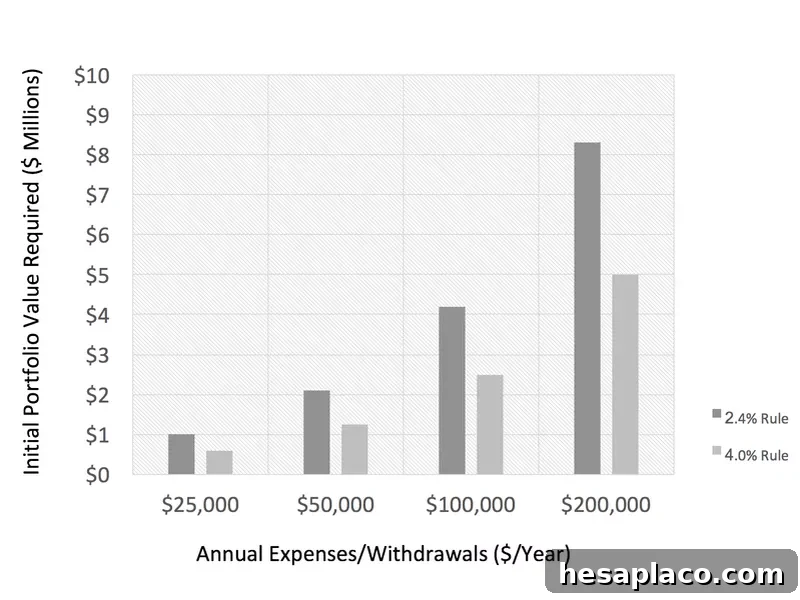
Rules of thumb like the 4 percent guideline are useful frameworks for thinking about saving and spending, and for estimating how much you might need before you retire. Yet when you build an actual annual budget, you should calculate real expenses: markets change, costs can spike, and personal circumstances evolve.
The difference between withdrawal rules can be dramatic. Under the traditional 4 percent rule, a $1 million portfolio would support roughly $40,000 per year (inflation-adjusted). Under a 2.4 percent rule, that annual figure falls to $24,000. Conversely, if you estimate needing $50,000 per year, the 4 percent rule implies a required nest egg of about $1.25 million, while a 2.4 percent rule pushes that target to roughly $2.08 million.
Those numbers can feel overwhelming. The most practical advice remains: start saving as early as possible, build a diversified portfolio, plan for contingencies like healthcare and longevity, maintain short-term reserves to weather market downturns, and reassess your withdrawal strategy as markets and personal circumstances change.
Begin with a clear view of the retirement you want, estimate likely expenses, and work with trusted financial guidance to craft a flexible plan that balances income needs, risk tolerance, and the realities of today’s markets.