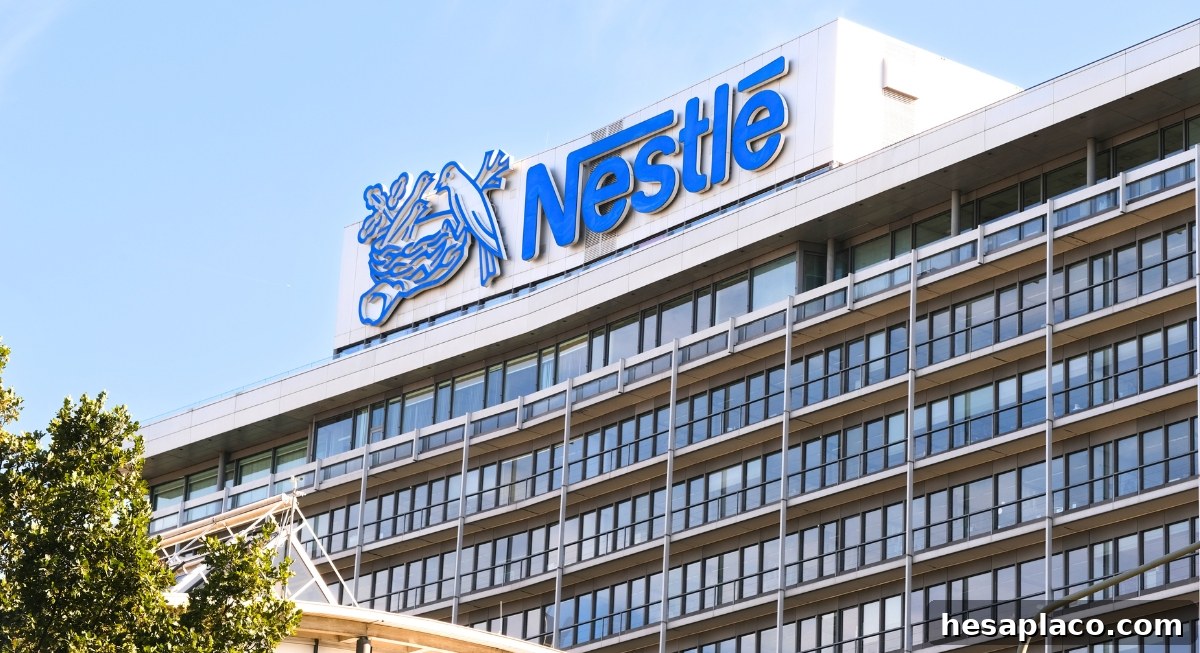
One of the world’s largest food companies has abruptly removed its chief executive after only a year in the role, drawing attention across the business world. Nestlé, the Swiss multinational known for Kit Kat, Purina, and Nespresso, announced the immediate dismissal of CEO Laurent Freixe after discovering he had not disclosed a romantic relationship with a direct subordinate. The action followed a whistleblower complaint and a subsequent internal investigation.
Although an initial inquiry turned up no evidence, further complaints prompted a second, independent review with outside counsel that substantiated the reports. Nestlé confirmed the board concluded Freixe had violated the company’s code of conduct and that his dismissal was effective immediately; the company also stated he would not receive an exit package.
The leadership change comes at a sensitive moment. Nestlé’s share price has fallen roughly 40% from its 2022 highs, and sales have softened this year, making the management shake-up an added source of uncertainty for investors and employees alike.
How the Issue Came to Light

Image via Canva/Lipik Stock Media
In early 2025, anonymous reports about Laurent Freixe’s conduct were submitted to Nestlé’s internal “Speak Up” hotline. The audit committee opened a preliminary inquiry, which initially did not find supporting evidence for the allegations.
When additional complaints were later filed through the same channel, the full board—led by chairman Paul Bulcke and supported by independent director Pablo Isla—ordered a more extensive investigation. To ensure independence and thoroughness, Nestlé engaged external legal counsel for the second review.
The outside-led inquiry determined that Freixe had an undisclosed romantic relationship with a Nestlé employee who was not a member of the executive board. Because that relationship represented a conflict of interest under Nestlé’s code of conduct, the board concluded he had breached company policy.
Freixe denied the allegations, but the board voted to terminate him. Nestlé emphasized that the process adhered to strong corporate governance practices throughout.
A Career Cut Short
Freixe’s dismissal abruptly ended a career at Nestlé that spanned nearly four decades. He joined the company in 1986 in France, working in marketing and sales, later leading the Nutrition Division in 1999, and serving as regional CEO for Europe and Latin America. In September 2024 he was appointed global CEO, succeeding Mark Schneider and becoming only the second outsider to assume the top role in Nestlé’s long history.
He positioned himself as an internal reformer, criticizing Schneider’s expansion into supplements and other non-core areas and pledging to refocus the company on its strengths: coffee, pet care, and core food categories. Despite those intentions, Freixe’s tenure struggled to gain traction.
By July 2025, Nestlé reported a 1.8% decline in half-year sales, with revenues of 44.2 billion Swiss francs (about $55 billion), underscoring the difficulties the company has faced amid changing consumer demand.
The New Leadership
Philipp Navratil has been appointed CEO. Navratil joined Nestlé in 2001 as an internal auditor and later held roles in Central America before moving into global leadership positions. By 2020 he was leading the Coffee Strategic Business Unit, and in 2024 he became CEO of Nespresso.
Chairman Paul Bulcke stated that the company’s strategic direction would remain unchanged under Navratil and sought to reassure investors that performance targets are still the priority. Navratil inherits a business under pressure: consumer demand has softened, the stock has fallen sharply since 2022, and management must restore momentum after a period of pandemic-driven volatility.
At the same time, Nestlé announced that Bulcke will step down as chairman next year, with Pablo Isla proposed as his successor—signaling further board-level transition.
Implications for Nestlé
Nestlé’s decision to remove a CEO who denied wrongdoing but was found to have breached policy sends a clear message about corporate accountability. With roughly 270,000 employees and more than 150 years of history, the company prioritized upholding its code of conduct at the highest level to preserve trust and credibility.
Looking ahead, the immediate challenge for Nestlé is to demonstrate stability and steady execution under Navratil while navigating a more demanding market. The company must balance leadership transitions with a renewed focus on growth and operational performance. How swiftly Nestlé can restore investor confidence, stabilize sales, and maintain its brand strength will determine whether the episode becomes a brief governance matter or a longer-term reputational issue.
Ultimately, the episode underscores the importance of transparent governance practices and the board’s willingness to act decisively when policies are violated—an example other large corporations are likely to watch closely.