While all U.S. currency issued by the federal government remains legal tender regardless of its age, the designs, denominations and circulation status of some coins and bills have changed over time. Shifts in commerce, technology and public preference often drive those changes; occasionally public opinion or practical considerations determine which coins and notes succeed and which are discontinued. Some denominations enjoyed brief popularity, others never gained traction, and a few were produced only as patterns or proofs and never entered general circulation.
$2 Bill
The first $2 bill appeared in 1862, initially featuring Alexander Hamilton, the inaugural U.S. Treasury Secretary. By 1869 Thomas Jefferson’s portrait replaced Hamilton’s and has remained on the $2 note in its various United States Note and Federal Reserve Note forms. In 1928 the reverse adopted an image of Jefferson’s Monticello, which persisted until 1976 when the reverse was changed to a depiction of the presentation of the Declaration of Independence. The current reverse reproduces a portion of John Trumbull’s painting, The Declaration of Independence.
Despite intermittent production spanning more than 150 years, the $2 bill has never been a mainstream favorite. Many people find it awkward to use, and those unfamiliar with the denomination sometimes assume it is counterfeit.
$3 Coin
The $3 gold coin was introduced in 1854. Congress and the Mint intended it to facilitate purchases like sheets of three-cent stamps, but public demand never materialized. Over 100,000 pieces were struck in the first year, yet circulation remained limited—especially during the Civil War, when gold became scarce in many regions. After the war the coin saw little commercial use and was often repurposed as jewelry or given as gifts.
Minted sporadically through 1889, total production of the $3 coin reached only about half a million. Congress declared the denomination obsolete in 1890, and tens of thousands were later melted at the Philadelphia Mint. As a consequence, surviving $3 coins are relatively rare today.
$4 “Stella”
The stella, named for the Latin word for “star,” originated from interest in international monetary standardization following the mid-19th-century formation of the Latin Monetary Union. In 1879 advocates in Congress proposed a $4 coin to align with certain foreign gold coins. Pattern stella coins were struck in 1879 and 1880, but legislation to authorize circulating $4 pieces failed to pass. As a result, the stella remained a pattern issue and never entered regular circulation.
Eisenhower Dollar
The Eisenhower dollar was introduced in 1971 to honor General Dwight D. Eisenhower and to celebrate the Apollo 11 moon landing, with Eisenhower’s portrait on the obverse and the Apollo 11 mission insignia on the reverse. Circulating strikes used the standard copper-nickel clad composition while a limited number of 40% silver collector versions were also produced. In 1975–76 a special Bicentennial design replaced the regular reverse to commemorate the Declaration of Independence.
Although millions of Eisenhower dollars were minted, their large size and weight made them impractical for everyday use. The coin remained more of a novelty than a widely circulated denomination, and production was discontinued after Congress reviewed dollar coin design and utility.
Susan B. Anthony Dollar
The Susan B. Anthony dollar was introduced in 1979 as a smaller successor to the Eisenhower dollar with the explicit goal of encouraging use of dollar coins. The government commissioned research that recommended several changes to make a new dollar coin more acceptable, but only size reduction was implemented. Lobbying by women’s organizations resulted in the selection of suffragist Susan B. Anthony for the obverse, replacing the originally planned allegorical Liberty.
Although intended to save on production and extend coin life, the Anthony dollar suffered from a major practical problem: its appearance and color made it easily confused with the quarter in everyday transactions, particularly in low light. Vending machine modifications and a modest marketing effort proved insufficient to drive widespread adoption. Production for circulation effectively ceased by 1981, and remaining Mint inventory lasted through the late 1990s.
Sacagawea Dollar
The Coinage Act of 1997 authorized another new dollar coin, retaining the physical size of the Anthony dollar but introducing a golden-colored alloy and a plain edge to distinguish it from other coins. In 1998 the Dollar Coin Design Advisory Committee recommended depicting Sacagawea, the Shoshone woman who aided the Lewis and Clark expedition. The chosen obverse by Glenna Goodacre and a reverse by Thomas D. Rogers were unveiled in 1999.
Initial enthusiasm, supported by a substantial marketing campaign and high-profile promotions, did not translate into sustained circulation use. As with previous dollar coins, Sacagawea dollars were often retained rather than spent because they were hard to distinguish from other coins, causing demand to fall. From 2002 to 2008 the Mint struck Sacagawea dollars primarily for collectors; annual production resumed later with rotating designs honoring Native American contributions.
Presidential Dollar Series
Enacted in 2005, the Presidential $1 Coin Act aimed to replicate the success of the state quarters program by issuing coins honoring two-term and single-term U.S. presidents. Four new presidential dollar coins were to be released each year, featuring a president on the obverse and the Statue of Liberty on the reverse. The program ran through 2016 and required that presidents be deceased for at least two years before being honored, effectively limiting the sequence.
Despite collector interest, the public did not adopt these dollars in general circulation. By 2011 the Mint had accumulated over a billion presidential dollars that never entered commerce, and production for circulation was suspended; later strikes were produced solely for collectors to complete the series.
Half Cent
The half cent was among the earliest U.S. Mint issues, first struck in 1793. At a time when many workers earned roughly a dollar a day, the copper half cent was useful for small everyday purchases. The denomination continued in production, with a brief pause in the late 1830s, until rising prices and inflation reduced its practicality. The half cent was discontinued in 1857, and many surviving pieces were melted for their copper content.
Large Cent
The large cent, also introduced in 1793, was notable for its physically large diameter compared with modern cents. Early large-cent designs included the Chain, Wreath and Liberty Cap varieties; the Liberty Cap design carried forward into later years. Several design changes occurred over the coin’s lifetime until production ceased in 1857. Its substantial size and weight made the large cent inconvenient, which contributed to its replacement by the smaller modern one-cent coin.
Quarter Eagle ($2.50)
The quarter eagle, a $2.50 gold coin authorized by the Coinage Act of 1792 and first struck in 1796, filled a niche in an era when gold coinage played a central role in commerce. Designs evolved over time and the gold content was reduced in 1834. Production continued into the early 20th century, with the last issues struck in 1929. When the United States left the gold standard in 1933, the quarter eagle was discontinued. Its unusual denomination made it less versatile in everyday commerce than more common values.
Half Union ($50 Pattern)
The so-called Half Union was a proposed $50 gold pattern coin produced as a pattern in 1877, prompted by banking and commercial interests in California after the West Coast mints opened. Although a Senate bill supporting the denomination once passed, the measure failed in the House and the Half Union never entered circulation. A few pattern specimens were retained by the Mint and by private collectors; these pieces are extremely rare and historically significant.
20-cent Piece
Introduced in 1875 to address small-change shortages in the Far West, the 20-cent coin aimed to make transactions simpler where quarters and other small denominations weren’t as available. The coin closely resembled the quarter in size and appearance, however, and confusion between the two limited public acceptance. Production was short-lived: many 20-cent pieces were eventually melted and Congress abolished the denomination in 1878.
Three-cent Piece
The three-cent coin was first authorized in 1851 to ease the purchase of three-cent postage stamps and to simplify making change in transactions involving half dimes. Early issues were small silver “fish scale” coins; after 1865 the denomination appeared as a larger copper-nickel “three-cent nickel.” The coin remained in production until 1889, when postal rate changes and evolving currency needs rendered the denomination obsolete. Millions were returned to the Mint and melted.
Two-cent Piece
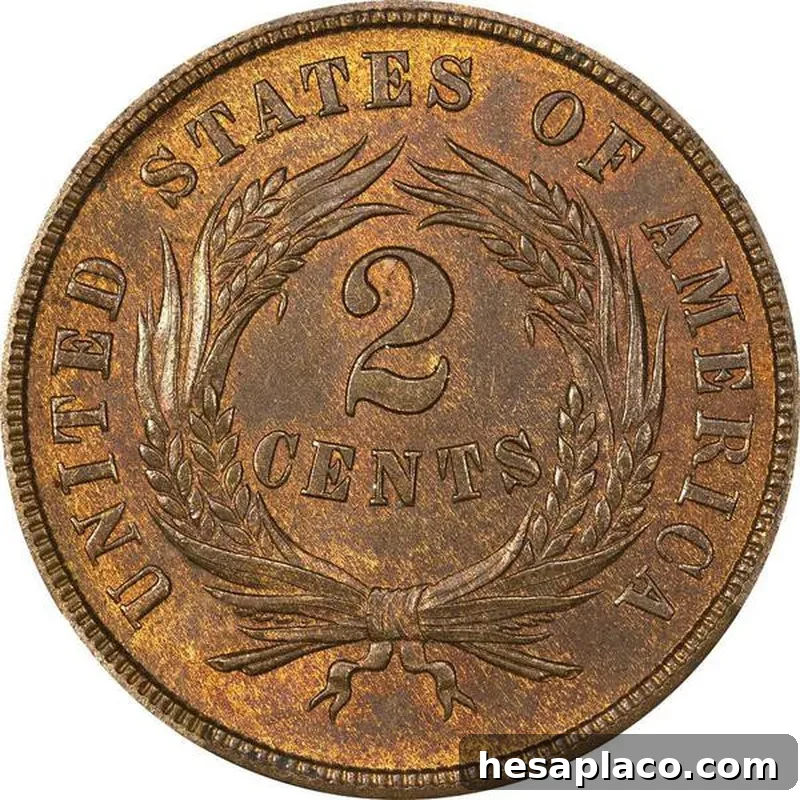
Created by the Coinage Act of 1864, the two-cent piece was the first U.S. coin to bear the motto “In God We Trust.” Introduced during the Civil War when hoarding and shortages were widespread, it was initially welcomed. Once normal coin circulation resumed after the conflict, demand for the two-cent coin declined and annual mintages dropped. The denomination was discontinued in 1873.
Franklin Half Dollar
Produced from 1948 to 1963, the Franklin half dollar featured Benjamin Franklin on the obverse and the Liberty Bell on the reverse; a small eagle was included to satisfy a statutory requirement that an eagle appear on half dollars. Early years saw modest demand because of a surplus of prior half dollars in circulation. The series ended quickly after President John F. Kennedy’s assassination, when Congress authorized a half dollar bearing Kennedy’s portrait in late 1963.
Fractional Currency
During the Civil War, shortages of precious metals prompted the government to accept postage stamps as small-change substitutes. When that measure produced a stamp shortage, the Treasury issued fractional paper currency in denominations under one dollar—three, five, ten, fifteen, twenty-five and fifty cents—between 1862 and 1875. Multiple issues refined size, added Treasury seals and changed portraits. One controversial design showing a living official led Congress to ban images of living persons on U.S. currency, shaping future note design policy.