
For decades, retirement advisers have urged people to start saving early and consistently to secure a comfortable retirement.
Only more recently have advisors focused on strategies for managing those savings once you stop accumulating wealth and begin drawing down your assets.
A central concern—how to avoid exhausting your savings before the end of your life—came into sharper focus in 1994 when William Bengen introduced the “safe withdrawal rule,” commonly known as the 4 percent rule.
The 4 Percent Rule

Bengen analyzed historical investment returns back to 1926 and concluded that a retiree with a portfolio split roughly 50/50 between stocks and bonds could withdraw 4 percent of the initial portfolio each year (adjusted for inflation) and have a low likelihood of running out of money.
The appeal of Bengen’s 4 percent rule lies in its simplicity. The challenge is that markets, interest rates and retirement realities have shifted since 1994, yet many still treat the rule as a one-size-fits-all solution. Financial advisers say it remains a useful starting point for setting retirement goals, but applying it effectively now requires more nuance and planning.
How Much Money Do You Need?

As David Chwalek of Senes & Chwalek Financial Advisors in Concord, Mass., explains, the single correct answer to “How much money do I need to retire?” is:
It depends.
“Everyone’s vision of retirement is different,” Chwalek says. “Some clients stay in the same home for decades and spend retirement on family, gardening and modest outings. Others choose second homes, frequent travel and more expensive lifestyles.”
That means you must be realistic about the retirement you envision and estimate how much that lifestyle will cost. Chwalek recommends using the 4 percent rule as an initial framework for managing spending, but he warns there are many caveats.
Market Fluctuations Matter
“If a retiree begins 4 percent withdrawals and their portfolio is invested aggressively, a sharp market drop in the first years of retirement can jeopardize their income,” Chwalek says. “If they have several years of income set aside in cash or conservative investments, they’re better positioned to ride out short-term declines.”
Planning Your Retirement Budget

Forecasting future expenses is difficult, according to Chris White, author of Working with the Emotional Investor: Financial Psychology for Wealth Managers. Unlike a monthly household budget with predictable items, major retirement expenses—especially healthcare—are uncertain and may rise substantially over time.
It’s also uncertain how much you can rely on Social Security, pensions and other non-investment income streams when applying a withdrawal rule.
Concerning Social Security
“Social Security may or may not be a significant source of income, and taxation or policy changes can reduce its value,” White says. “Pensions are extremely valuable, but if they aren’t adjusted for inflation, their real purchasing power will decline over time.”
Concerning Healthcare Costs
Healthcare inflation typically outpaces general inflation. White recommends researching historical healthcare costs in the region where you plan to retire and projecting major expenses over your retirement years. Then compare those projected costs to expected income from your portfolio to test sustainability year by year.
Why the 4 Percent Rule May No Longer Work

Advisors note the 4 percent rule was developed in an era of higher, more predictable bond yields. Today’s low bond yields and changed market dynamics mean a 60/40 portfolio may not support a 4 percent initial withdrawal without increasing the risk of depleting assets. Brian Saranovitz, co-founder of Your Retirement Advisor, suggests a safer initial withdrawal rate today could be 2–3 percent unless retirees adopt different portfolio constructions or income strategies.
Saranovitz recommends that retirees who want to maintain higher withdrawal levels consider combining equities with fixed indexed annuities and structured withdrawal plans. His Multi-Discipline Retirement Strategy blends globally diversified stocks with annuities, a systematic withdrawal plan and buffer strategies to guard against severe market losses.
Retirement Risk Factors

Retirement Risk Factor #1: Living Too Long
Longer retirements are increasingly common as life expectancy rises. The primary danger is inflation: even modest inflation compounds over decades. For example, $3,000 per month at age 65, growing at 3 percent inflation, becomes roughly $5,432 per month by age 85. Without planning for longevity and inflation, many retirees risk a significant shortfall between saved assets and actual needs.
To combat this, retirees should avoid overly conservative portfolios that underweight stocks. Historically, equities have been the best asset class to outpace inflation, and a diversified stock allocation helps preserve purchasing power while mitigating volatility through a mix of asset classes.
Retirement Risk Factor #2: Volatility
Standard deviation—an academic measure of how much returns deviate from the average—can help gauge portfolio volatility. Higher volatility raises the risk of failure for a withdrawal plan, so retirees should assess whether their assets’ expected swings align with their ability to tolerate drawdowns.
Retirement Risk Factor #3: Sequence of Return
Sequence-of-return risk means that poor returns early in retirement can have an outsized negative effect. Withdrawing the same dollar amount from a portfolio after it has fallen in value has a larger impact on long-term sustainability. A useful defense is a “safe bucket” of conservative assets to fund early retirement withdrawals, allowing equity holdings time to recover without forced selling at depressed prices.
A buffer can be cash, CDs, life insurance cash values, a reverse-mortgage reserve, a guaranteed annuity, or other conservative accounts. Besides protecting principal, a buffer often reduces anxiety and helps retirees avoid panic selling during market downturns.
Retirement Risk Factor #4: Interest Rates
Bonds move inversely to interest rates. With historically low interest rates in recent years, bond returns have been challenged, and future returns may disappoint—possibly even producing negative real returns after inflation. That reduces the traditional role bonds played in retirement portfolios when the 4 percent rule was developed.
Bonds still matter, but many advisers now recommend a smaller allocation to fixed income or seeking alternatives, combined with a more thoughtful equity allocation to manage long-term inflation risk, even if that increases short-term volatility.
The New Safe Withdrawal Rule

A 2013 Morningstar analysis revisited Bengen’s work and suggested a lower “safe” initial withdrawal rate—about 2.4 percent annually for a 60/40 portfolio—finding that a 4 percent real withdrawal rate has roughly a 50 percent probability of success over a 30-year period under modern assumptions. This highlights how changing market conditions can dramatically affect what withdrawal rates are reasonably considered safe.
Of course, market conditions and financial products continue to evolve, so any single fixed rule risks becoming outdated as circumstances shift.
A New Approach

Some advisers now recommend blending growth assets with guaranteed-income products such as fixed indexed annuities (FIAs). FIAs can credit a percentage of an index’s return without exposing the principal to market declines. They act as a “safe money” alternative to bonds by providing principal protection and downside limits, while still offering potential upside credits in favorable years.
Used thoughtfully, annuities and other guaranteed-income strategies can form part of a diversified retirement blueprint that balances growth, income and protection against severe market stress.
The Numbers Get Daunting
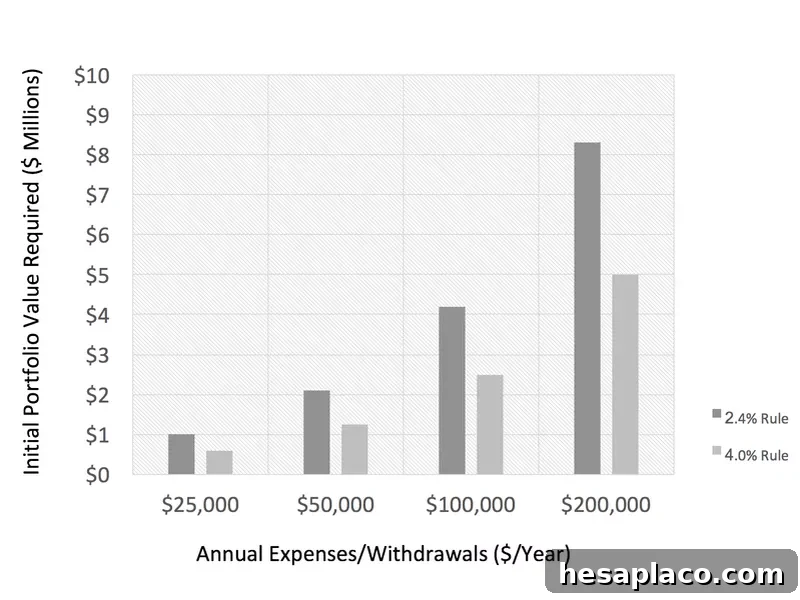
Rules of thumb are useful frameworks to shape thinking about spending, saving and investing. They help set retirement targets for those still working. However, when it’s time to build a practical annual retirement budget, you should model your actual expenses because markets fluctuate, costs can surge, and personal circumstances change.
Consider the difference in annual spending those rules imply. Under the traditional 4 percent rule, a $1 million portfolio supports an inflation-adjusted $40,000 per year. At a 2.4 percent withdrawal rate, that same portfolio supports only $24,000 per year. If you believe you’ll need $50,000 per year in retirement, the 4 percent rule implies a $1.25 million target, while the 2.4 percent guideline suggests you would need roughly $2.08 million.
Those figures illustrate how daunting planning can feel—and why a tailored approach matters. Start saving early, plan for inflation and longevity, consider a mix of growth assets and guaranteed options, maintain a conservative “safe bucket” for early withdrawals, and review your plan regularly as market conditions and personal circumstances change.