Behind one of the world’s most beloved toys is an origin story few would guess. For many, Play-Doh evokes childhood nostalgia, but it was not originally created for children. The colorful modeling compound began in Cincinnati as a wallpaper cleaner formulated to remove coal soot from household walls.
The journey from wallpaper cleaner to children’s plaything is nearly a century-old tale involving a family company that almost failed before transforming into one of the most remarkable reinventions in consumer products history.
A Cleaner That Kept a Company Alive
Image via Wikimedia Commons/Letstown
Kutol Products was a Cincinnati soap maker clinging to survival in the 1930s. At that time, many homes were heated with coal, leaving a sooty film on wallpaper that could not be cleaned with water alone. When grocery chain Kroger ordered 15,000 cases of wallpaper cleaner, 21-year-old Cleo McVicker promised he could deliver—though he did not yet have a formula.
His brother Noah developed a pliable putty that rolled soot away without tearing delicate wallpaper. The gamble paid off: Kutol became the leading manufacturer of wallpaper cleaner in the United States.
For a couple of decades business prospered, but change arrived quickly. Oil and gas furnaces replaced coal, and washable wallpaper became common. By the late 1940s, sales plunged, and Kutol looked likely to close. Cleo McVicker died in a plane crash in 1949, and his nephew Joseph McVicker took charge. Young and battling cancer, Joseph needed a new product to revive the company.
A Teacher Spots the Potential
The breakthrough came in 1954 through Joseph’s sister-in-law, Kay Zufall, a nursery school teacher. Looking for a safe material for classroom crafts, she discovered Kutol’s wallpaper cleaner. Children loved squishing and shaping it. Kay recognized its potential as a toy and urged the family to market it that way. She also rejected Joseph’s first name suggestion, “Kutol’s Rainbow Modeling Compound,” and proposed the simpler, catchier Play-Doh.
The transformation was straightforward but effective. Manufacturers removed the detergent, added food coloring, and replaced the cleaner’s odor with a mild almond scent. In 1956, Kutol created a subsidiary called Rainbow Crafts to market the product, initially packaging it in gallon-sized cans for schools. Cincinnati classrooms were the first adopters, and teachers quickly noticed how much children enjoyed molding the dough.
The Leap to Toy Store Shelves
Image via Wikimedia Commons/Nevit Dilmen
While schools provided Play-Doh’s initial success, retail distribution was the key to broad popularity. At a 1956 trade convention, the Washington, D.C., department store Woodward & Lothrop agreed to carry the product, soon followed by Macy’s and Marshall Field’s. The company repackaged Play-Doh into smaller seven-ounce cans in primary colors—red, blue, and yellow—making it more appealing to consumers.
The turning point came in 1957 with television. Joseph McVicker struck a deal with Bob Keeshan, better known as Captain Kangaroo, one of the era’s most popular children’s TV hosts. Lacking an advertising budget, Joseph offered Keeshan a share of sales in exchange for featuring Play-Doh on the show. Keeshan agreed and showcased the dough repeatedly, exposing it to a national audience. Other children’s programs such as Romper Room and Ding Dong School followed, and demand skyrocketed. The company struggled to keep up with backorders for more than a year.
Patents, Profits, and Big Sales
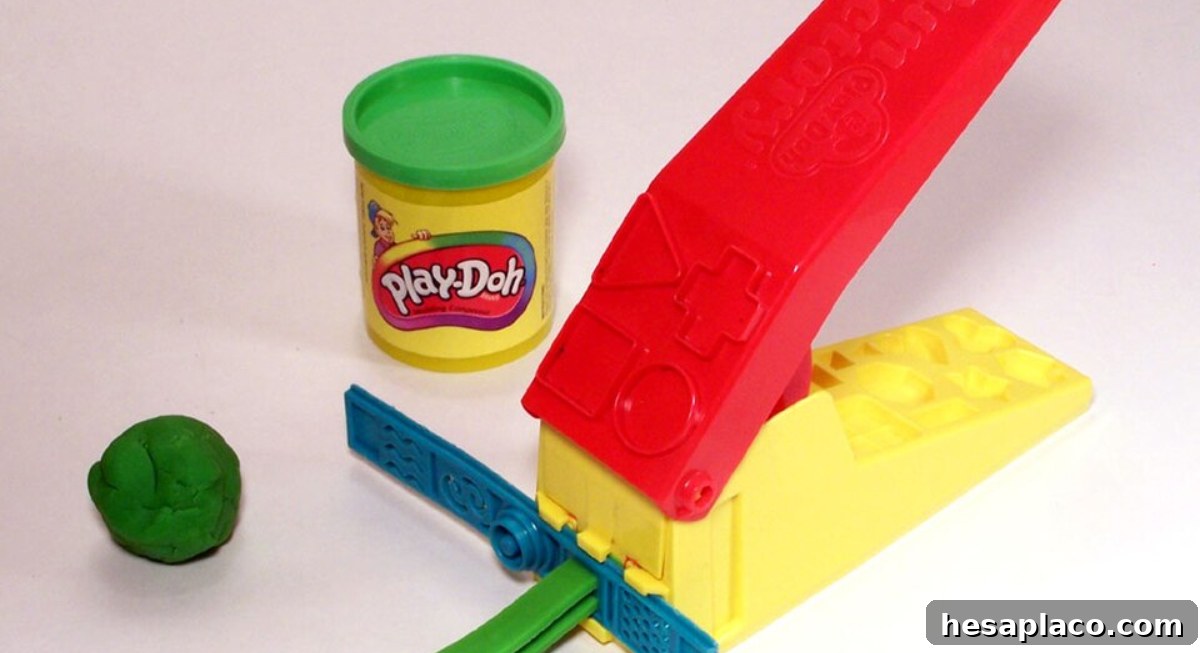
By the early 1960s, Play-Doh sales approached $3 million annually. The compound had once sold as wallpaper cleaner for about 34 cents a can; selling it as a toy for $1.50 a can represented a substantial turnaround. Accessories like the Play-Doh Fun Factory, introduced in 1960, fueled further interest and expanded creative play possibilities.
A patent application was filed in 1956 and the patent was granted in 1965. That same year General Mills bought Rainbow Crafts for $3 million. The brand later transitioned to Tonka and ultimately to Hasbro in 1991, where Play-Doh remains today. The basic recipe has changed little, with minor adjustments over time to keep the compound softer and longer-lasting.
Since its relaunch as a toy, Play-Doh has sold more than 3 billion cans worldwide. Hasbro once estimated that if all Play-Doh ever produced were rolled into a single strand, it could circle the Earth hundreds of times. Recognized for its cultural impact, Play-Doh holds a place in the National Toy Hall of Fame and consistently ranks among the top creative play products.
Play-Doh is also known for its distinctive scent. In 2018 Hasbro applied for a trademark describing the fragrance as a sweet, slightly musky, vanilla-like aroma with cherry overtones and the natural smell of salted, wheat-based dough. For its 50th anniversary in 2006 the company even released a novelty perfume inspired by that scent.
Today Play-Doh remains a fixture on toy store shelves, expanded into a variety of spinoffs including slime, foam, and glitter putties, continuing a legacy that began with a soap company’s unlikely solution to sooty wallpaper.