
In 2019 I published a piece titled “Buying The Haystack: Sleeping Well Because I’ll Own The Winners (Needles).” Recently, Hendrik Bessembinder released an update to his long-term research in the paper “One Hundred Years in the U.S. Stock Markets” (SSRN/PDF). His study examines investment outcomes for 29,754 common stocks listed on U.S. public markets from 1926 through 2025 and highlights some striking findings about how value is created across the market.
- Total net wealth created across that 100-year period is estimated at roughly $91 trillion.
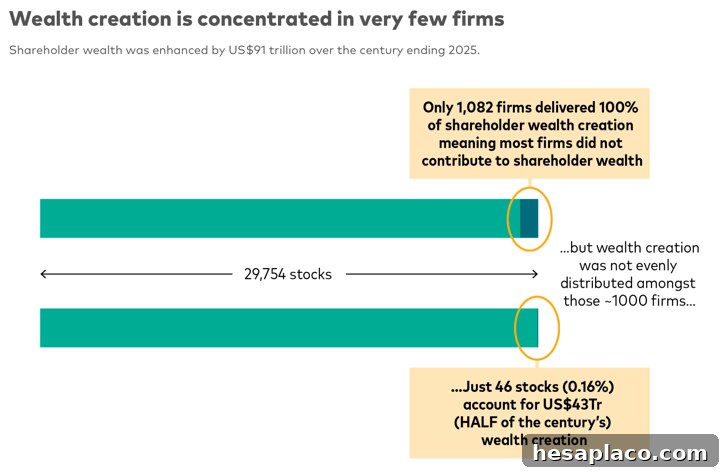
- The 0.2% Needles: Just 46 stocks — about 0.2% of the nearly 30,000 companies studied — were responsible for generating 50% of that $91 trillion in net wealth.
- The 4% Needles: Only about 4% of all stocks accounted for 100% of the net value creation. The remaining 96% collectively returned roughly the same as risk-free U.S. Treasury bills: many of those companies were complete or nearly complete losses, and the rest produced only modest gains that largely offset those losses. In short, outsized wealth creation is concentrated in a very small subset of companies.
The skew in returns is visually summarized below, drawn from a Vanguard Australia article that discusses equity market skewness and the case for diversification:
This concentrated pattern of winners reinforces a simple, long-standing investment philosophy: you can’t reliably pick the tiny number of future mega-winners in advance, but you can own them collectively through broad market exposure. The late John Bogle captured this idea succinctly: “Don’t look for the needle in the haystack. Just buy the haystack.”
That approach explains why many low-cost index investors choose to hold broad-market funds rather than attempt to identify a handful of future giants. By owning a total market index fund, an investor automatically owns the handful of extraordinary performers that will drive long-term net wealth creation, along with the many companies that generate modest returns or fail entirely. Over long horizons, the few outsized winners can more than offset the large number of disappointing outcomes.
To put the idea in practical terms: I don’t know today which companies will become tomorrow’s dominant winners, but by holding a total U.S. market index fund I will own those future winners regardless of whether they are familiar names now or unknown startups. In my global allocation I also hold broad international equity exposure, so if the next transformative firms arise outside the United States they are included as well.
Today, in 2026, a large portion of my equity exposure includes companies such as NVIDIA, Alphabet (Google), and Microsoft. Those firms are currently major contributors to my portfolio’s performance, but I also recognize that the composition of top performers will evolve over time. In ten or twenty years the set of companies responsible for the largest share of net wealth creation is likely to look different, and the diversification afforded by total market funds helps ensure I capture that future upside without needing to predict precisely which firms will lead.
Key implications for investors from this body of research:
- Diversification matters: Because outsized returns are concentrated in a tiny fraction of companies, broad exposure gives you access to the winners you cannot reliably identify in advance.
- Indexing reduces selection risk: Attempting to pick a small number of winners increases the chance of missing the few companies that generate the bulk of wealth creation.
- Expect skewed outcomes: Over long horizons, a small group of winners often accounts for most of the market’s total gains, while most stocks deliver average or poor outcomes.
- Maintain long-term perspective: The timing and identity of mega-winners change across decades; long-term, passive ownership captures those shifts without frequent trading or market timing.
Investment writing often boils down to repeating a core set of durable principles because those rules have stood the test of time: keep costs low, diversify broadly, and stay invested for the long run. Bessembinder’s century-spanning analysis simply reinforces these lessons with empirical evidence that net wealth creation in public markets is heavily skewed toward a very small percentage of companies.
Owning the “haystack” — not hunting individual needles — remains a practical strategy for most investors who want exposure to the potential winners without taking on the concentrated risk of stock-picking. It’s not glamorous, and it won’t guarantee that any single investor captures every top performer, but over long timeframes it’s an efficient, evidence-based way to participate in the market’s long-run wealth creation.