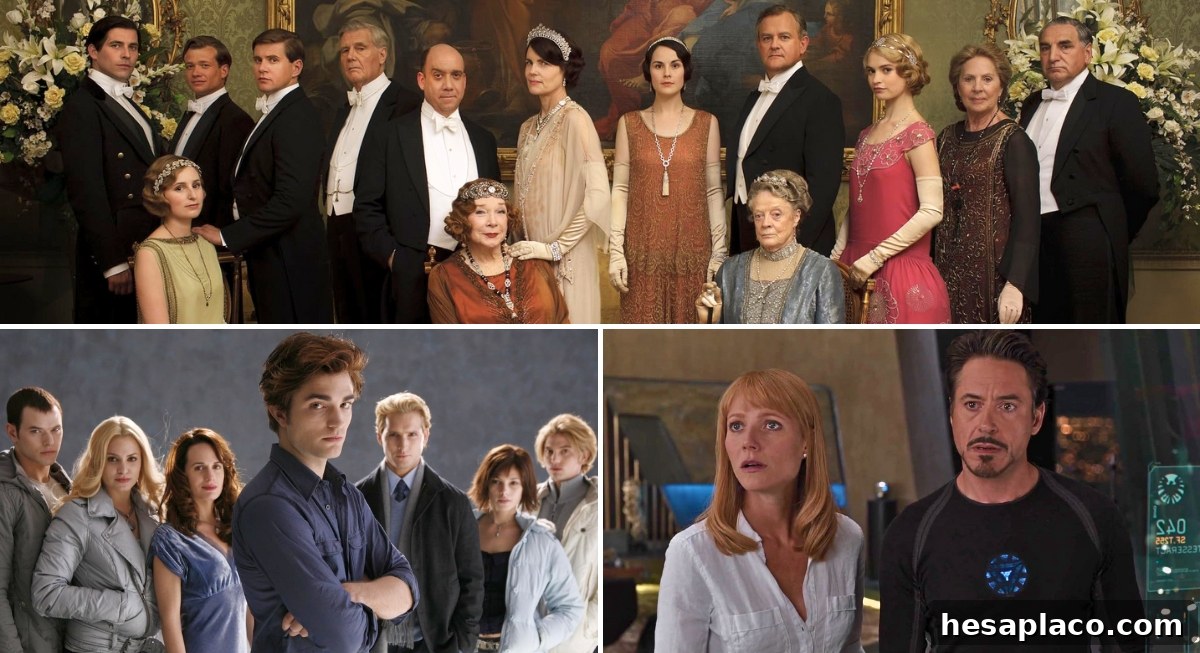
Fiction has long been fascinated with families whose wealth dwarfs ordinary fortunes. Some fictional dynasties are so lavish that real-world billionaires start to look modest by comparison. These fortunes come from a range of imaginative sources: rare materials, inherited estates, long-running commercial empires, or centuries of compounded investments. Converted into contemporary values, the families below rank among the richest in fiction, offering a sense of scale that highlights how these imagined fortunes function within their respective stories.
Crawley Family – Estimated ~$1.47 Billion

Credit: IMDb
The Crawleys of Downton Abbey represent an aristocratic fortune grounded in land, titles, and inheritance laws. Modern estimates—like those from Forbes—translate the estate’s Downton-era wealth into present-day terms, suggesting a figure around $1.47 billion. That calculation factors in landed property values, inheritance patterns that concentrate wealth in an heir, and the boost from Cora’s American dowry. The estimate is designed to convey the relative size of a period aristocrat’s resources, rather than serve as a literal currency conversion.
House Lannister – Estimated ~$2 Billion

Credit: IMDb
In the world of Westeros, the Lannisters’ wealth is frequently described as immense—much of it derived from the gold mines at Casterly Rock. Attempts to convert fictional gold reserves into modern dollars place House Lannister near the $2 billion mark. While such figures remain speculative, they reflect the Lannisters’ long-standing economic dominance and their political leverage within George R.R. Martin’s saga.
Rich Family – Estimated $8.9 Billion

Credit: IMDb
The Rich family—best known through the Richie Rich comics—epitomizes an over-the-top industrial and commercial empire. Valuations around $8.9 billion reflect a diversified conglomerate of businesses and investments that supply a cartoon mansion with every conceivable luxury. Richie’s portrayal as the “world’s richest kid” plays on the humor and excess of an inherited industrial empire that never has to worry about money.
Wayne Family – Estimated $9.2 Billion

Credit: IMDb
Bruce Wayne’s fortune blends old Gotham family wealth with modern technological enterprise. Forbes-style estimates put Wayne’s net worth at roughly $9.2 billion, based on the broad business footprint of Wayne Enterprises—defense contracting, technology R&D, construction, and real estate. Part of that wealth is famously funneled into an armored suit and sophisticated equipment, though the company’s real-world analogues would account for the bulk of the valuation.
Clampett Family – Estimated $9.8 Billion

Credit: IMDb
The Clampetts’ rise to riches is a classic sudden-windfall story: an accidental discovery of oil on rural land transforms a simple family into millionaires—and eventually billionaires by modern valuation. The sitcom narrative centers on how newfound wealth changes lifestyle and opportunities, and conservative estimates place the Clampett family’s fortune near $9.8 billion once investments and estate growth are taken into account.
Roy Family – Estimated ~$18–19 Billion

Credit: IMDb
Succession’s Roy family runs Waystar Royco, a media and entertainment conglomerate whose assets span news networks, streaming and production, theme parks, and global influence. Forbes-style assessments commonly place the Roy family’s aggregate holdings between $18 and $19 billion, a reflection of the company’s broad revenue streams and strategic value. The series emphasizes the volatility of power and succession, but the financial base of Logan Roy’s empire remains substantial.
Cullen Family – Estimated ~$46 Billion

Credit: IMDb
The Cullen family’s exceptional longevity—vampire immortality—creates a unique financial advantage. Carlisle Cullen’s early investments, begun centuries ago, had centuries to grow through compound interest. Financial commentators and fan estimates put the family’s modern portfolio between roughly $34 billion and $46 billion, driven by diversified holdings in stocks, real estate, and other assets that benefit from uninterrupted, long-term strategy.
McDuck / Duck Family – Estimated $65.4 Billion

Credit: IMDb
Scrooge McDuck’s fortune is one of fiction’s most vivid manifestations of wealth: a literal Money Bin filled with gold coins. Forbes once estimated Scrooge’s net worth at about $65.4 billion, reflecting earnings from mining, treasure hunting, resource exploitation, and decades of aggressive deal-making. That treasure chest is a recurring gag in comics and cartoons, but it also serves to illustrate the scale and durability of the McDuck family’s wealth.
Stark Family – Estimated $85.6 Billion

Credit: IMDb
Stark Industries, famously associated with Tony Stark, evolved from an arms manufacturer into a tech and engineering juggernaut. Contemporary valuations place the Stark family’s wealth at roughly $85.6 billion, driven by defense contracts, intellectual property, advanced R&D, and high-value patents. The company’s continued innovation and commercialization of cutting-edge technologies underscore the sustained high valuations associated with the Stark name.
Wakandan Royal Family – Estimated $500 Billion

Credit: IMDb
Wakanda’s royal family sits at the top of fictional wealth rankings largely because they control the world’s only known supply of vibranium. That rare and extraordinarily valuable metal underpins Wakanda’s advanced technology, strategic leverage, and economic strength. Analysts and popular estimates, including those referenced in mainstream outlets, have placed King T’Challa’s—or Wakanda’s—wealth near $500 billion in modern terms. Even conservative valuations make the Wakandan monarchy the richest fictional dynasty listed here, thanks to vibranium’s uniqueness and global value implications.
These estimates are inherently interpretive—translating narrative wealth and fictional assets into contemporary monetary terms requires assumptions about market value, resource scarcity, and the mechanisms of investment. Still, they offer a useful way to compare how different stories conceive large-scale wealth: some fortunes are rooted in land and inheritance, some in industrial empires and technology, and others in rare materials or centuries of compounded returns. Together they map a landscape of fictional riches that continues to fascinate readers and viewers alike.