
Automotive safety regulations shape how vehicles are designed to protect drivers, passengers, and vulnerable road users, and these rules differ significantly between regions. The European Union has adopted broader and stricter standards in recent years, raising the baseline for safety features that are often optional in the United States. These differences influence vehicle design, testing protocols, and consumer safety expectations across markets.
Driver Distraction Warning

Credit: Africa Images
European regulations now require systems that detect when a driver’s attention lapses. These driver monitoring technologies track eye movement and head position to spot signs of distraction or drowsiness and provide a clear alert when the driver’s focus deteriorates. In the U.S., similar features remain largely optional and are most commonly found on higher-trim or luxury models rather than as a mandated safety baseline.
Alcohol Interlock Compatibility

Credit: Getty Images
To better enforce repeat DUI sanctions, Europe requires new vehicles to be compatible with alcohol interlocks. Effective since 2024, this requirement does not force every car to carry a breathalyzer but ensures that vehicles can be readily fitted with one when ordered by authorities or courts. The measure facilitates targeted enforcement while preserving flexibility for individual vehicle owners.
Automatic Emergency Braking

Credit: Canva
Automatic emergency braking (AEB) is increasingly common in U.S. vehicles and is required by forthcoming federal rules to detect other vehicles starting in 2029. However, European mandates are broader: AEB systems there must also detect pedestrians and cyclists, expanding protection beyond vehicle-to-vehicle scenarios. This divergence means European AEB systems are generally designed to address a wider range of collision risks.
Rear Seatbelt Reminders

Credit: Canva
Since 2021, all new cars sold in Europe must include reminders for rear-seat occupants to buckle up. These systems typically combine a chime with a dashboard warning when unbuckled passengers are detected. The U.S. has approved a comparable rule, but it is not due to take effect until 2027; until then, rear seatbelt reminders are implemented at manufacturers’ discretion.
Intelligent Speed Assistance

Credit: Getty Images
Intelligent Speed Assistance (ISA) uses GPS data and traffic-sign recognition to monitor local speed limits and warn drivers or intervene by limiting engine power when a vehicle exceeds the limit. ISA became mandatory for new cars in Europe in 2024, aiming to reduce speeding-related crashes. In the United States, drivers still primarily rely on speedometers and law enforcement for speed management, and ISA is not yet a widespread regulatory requirement.
Pedestrian Impact Standards

Credit: Getty Images
European crash testing includes assessments for pedestrian impacts, and vehicle design requirements reflect that emphasis. Automakers are guided to engineer softer hoods, energy-absorbing bumpers, and front-end structures that minimize injury to heads and legs in collisions with pedestrians. These protective elements have been phased in gradually since the mid-2000s, contributing to safer outcomes for people struck by vehicles.
Convex Side Mirrors

Credit: Getty Images
Side mirror regulations differ between the U.S. and Europe. In the United States, federal rules commonly require a flat driver-side mirror while allowing a convex passenger-side mirror, which can limit the driver’s lateral field of view and increase blind spots. In many European vehicles, both side mirrors are often convex, providing a wider view and better awareness of adjacent traffic—especially useful during lane changes and merging.
Lane Departure Warning

Credit: Canva
Europe has required lane departure warning systems on heavy vehicles like trucks and buses since 2015, helping to prevent lane-drift incidents. In the United States, adoption on heavy commercial vehicles is more uneven: some fleets, especially newer or safety-focused operators, install lane-departure systems voluntarily, but there is no uniform federal mandate for all heavy vehicles.
Side Underrun Protection
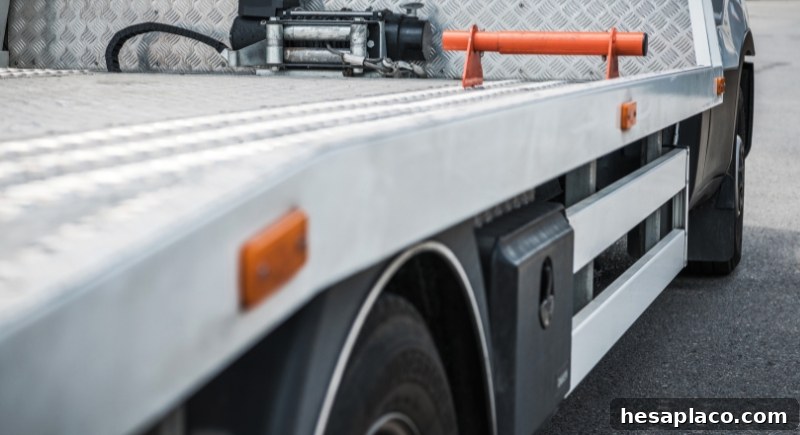
Credit: Canva
To protect pedestrians and cyclists near large trucks, Europe established side underrun protection requirements starting in the early 1990s. These metal guards run along truck and trailer sides to prevent people from being pulled underneath during a collision. The standard was introduced in response to rising urban fatalities involving vulnerable road users and remains a key safety feature on commercial vehicles in many countries.
eCall Emergency System

Credit: Canva
After a serious collision, many vehicles in the U.S. depend on optional, subscription-based services to contact emergency responders, which can leave gaps in coverage if a subscription lapses or a vehicle lacks the service. Europe, by contrast, requires new cars to include eCall, a built-in automatic emergency call system that notifies emergency services and transmits the vehicle’s location after a severe crash, improving the speed and reliability of post-crash assistance.
Overall, the EU’s regulatory approach mandates a wider set of active and passive safety technologies across vehicle categories, while the U.S. has relied more on voluntary adoption, phased federal rules, and market-driven availability. These regional differences shape both vehicle safety equipment and how effectively vehicles protect all road users.