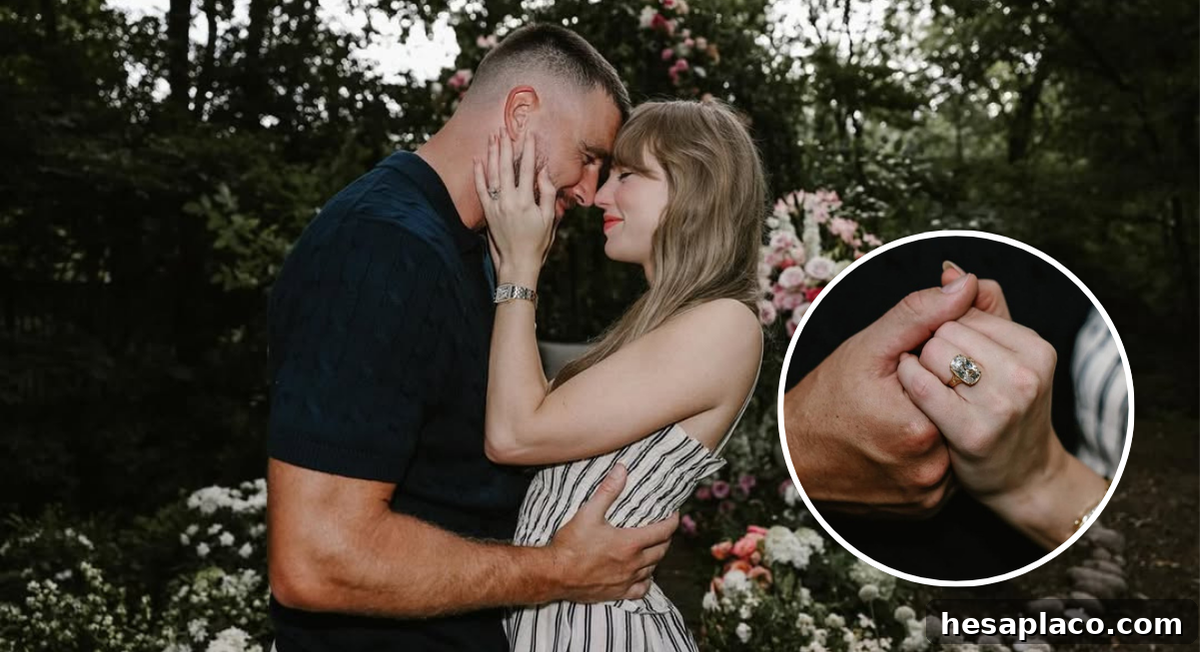
An engagement announcement rarely sends ripples through global markets, but Taylor Swift and Travis Kelce’s news did just that.
On Tuesday afternoon, a single Instagram photo of the couple embracing — accompanied by the caption “Your English teacher and your gym teacher are getting married” — instantly dominated social feeds and conversations worldwide. While fans analyzed every detail of the post, financial markets reacted in real time.
By about 1 p.m. Eastern, shares of Signet Jewelers, the parent company of Zales and Kay, rose on unusually heavy trading volume. More notable was the spike in Brilliant Earth’s stock, surging more than 26%. Investors weren’t merely speculating on celebrity influence; they were responding to what the ring itself implied about consumer tastes and the direction of the jewelry market.
What’s the ring, exactly?
Instagram @taylorswift
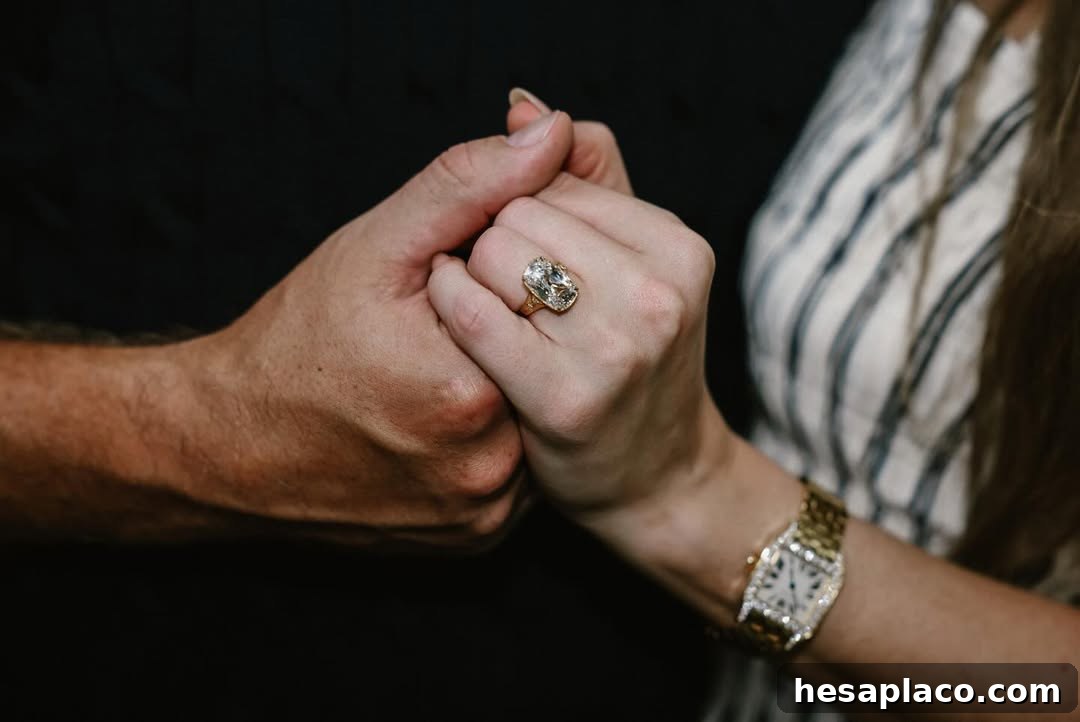
Industry observers estimate the center stone to be an elongated Old Mine cut diamond in the 8–12 carat range. This is not the modern brilliant cut optimized for maximum sparkle and standardized grading; it’s an antique hand-cut stone with distinct character.
Old Mine cuts feature chunky facets and a large open culet — signs of manual craftsmanship from a bygone era. Importantly, the ring reportedly came not from a global luxury house but from Kindred Lubeck of Artifex Fine Jewelry, a bespoke maker. That choice emphasizes scarcity and storytelling over uniform metrics and mass production.
This ring is strategic
The selection of a centuries-old natural diamond functions as more than a stylistic preference; it serves as a strategic move in the broader contest between mined and lab-grown diamonds. Lab-grown stones have increasingly commoditized the market by offering near-flawless clarity and color at much lower prices, effectively turning perfection into a mass-market feature.
Faced with that reality, the natural diamond sector has shifted focus away from competing on price or technical perfection and toward what a lab cannot replicate: provenance, history, and singularity. An antique, hand-cut stone embodies those qualities — it cannot be mass-produced or perfectly replicated.
By choosing a historic, imperfect gem, the couple — and the public attention surrounding them — inadvertently mounted a powerful rebuttal to the notion that flawless, lab-grown stones are the pinnacle of desirability. The ring reframes value toward narrative, uniqueness, and romantic provenance.
The implications for diamond desirability
This moment may accelerate a widening split in the diamond market. For decades, marketing from major players positioned flawless, brilliantly cut stones as the ultimate symbol of status and romance. Lab-grown diamonds disrupted that narrative by making technical perfection accessible and affordable.
Could this be the end of the flawless diamond?
Taylor Swift’s ring offers a counter-narrative: the visible flaws and handmade qualities are the selling points. The large open culet and irregular facets are not defects but markers of age, craft, and individuality — a kind of authenticity certificate that no laboratory process can reproduce.
Consequently, the market is likely to continue bifurcating. Mainstream retail and online jewelers — the mass market — will increasingly favor lab-grown diamonds for buyers seeking predictable specs and value. Meanwhile, the upper tier of the luxury market will lean into rarity, heritage, and storytelling. High-end consumers will prioritize provenance and the human touch inherent in antique or bespoke pieces.
That shift matters in part because of Taylor Swift’s cultural influence. Her choice functions as a highly visible demonstration of how legacy brands and artisanal makers can reclaim distinct luxury positions by emphasizing narrative over standardized perfection. In an era when many products are commoditized, selling the story becomes the competitive advantage.
In short, the engagement ring’s prominence is more than celebrity gossip: it highlights a broader reorientation in how value is perceived within the diamond industry. Rather than elevating flawless perfection, the most culturally resonant choices may now celebrate imperfection, history, and singular human craftsmanship.