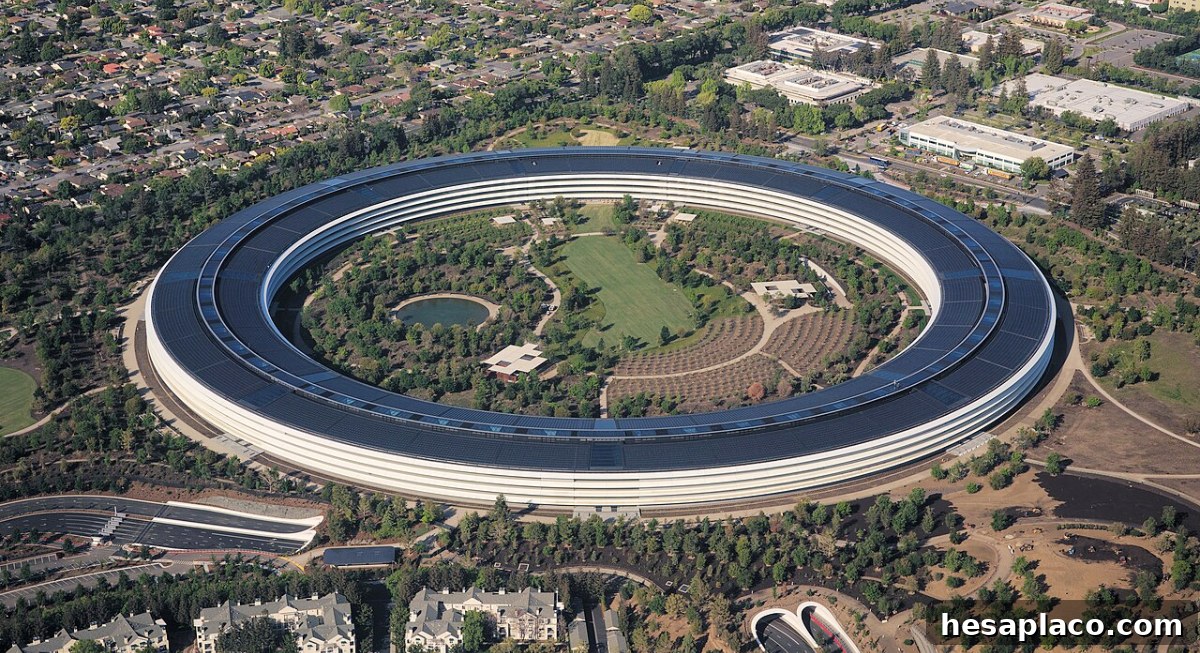
You can’t really see much of Apple’s headquarters unless you’re inside it. From the outside it resembles a glass ring rising from the green hills of Cupertino. What’s striking is how deliberately it’s designed to contain activity and control access.
Apple Park has been described as a spaceship, an emblem of perfection, and a monument to secrecy. Costing billions and stretching nearly a mile in circumference, it is visually stunning and highly efficient, yet nearly impossible to enter. What happens behind those glass walls remains private, and the design itself reveals something about the company’s priorities.
The Ring That Rules Them All
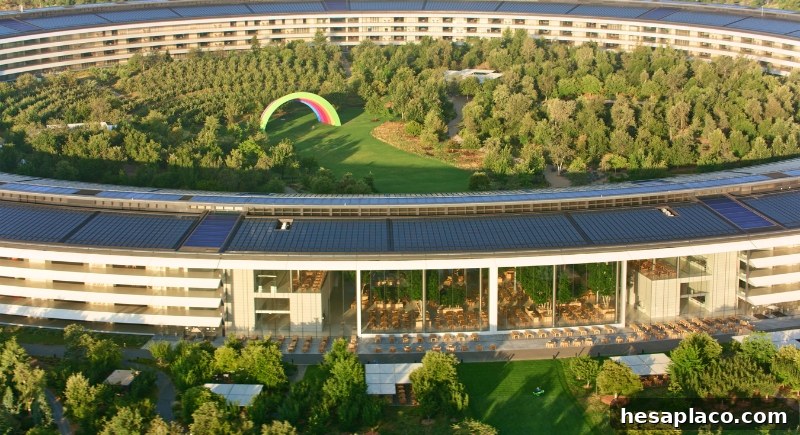
Image via iStockphoto/simonkr
At the center of Apple Park sits The Ring, a four-story circular building designed to accommodate more than 12,000 employees. Nearly a mile around, it reportedly cost about $5 billion to build. Its exterior is made of roughly 800 curved glass panels, each about forty-five feet tall, making it one of the largest glass structures constructed. The aesthetic—sleek, minimalist, refined—echoes Apple’s product design language.
The campus covers roughly 175 acres and is planted with around 9,000 trees, with walking trails winding through the grounds. With about 80 percent of the site dedicated to landscaping, Apple Park feels more like a vast public park with a workplace at its center than a conventional corporate campus.
Steve Jobs’ Last Masterpiece
In 2011, months before his death, Steve Jobs presented the vision for Apple Park to the Cupertino City Council. He wanted a place that blended technology and nature, avoiding the sterile, impersonal feel of standard corporate facilities.
Renowned architect Norman Foster translated that vision into a contemporary yet context-sensitive design. The campus’s gentle berms and contours were shaped using soil excavated on-site, integrating the buildings with the landscape.
Jobs was involved in minute design decisions—from stair details to tree placement—seeking a workplace that encouraged spontaneous encounters and collaboration. Ironically, that vision of openness coexists with one of the most exclusive and tightly controlled offices in Silicon Valley.
Apple Park was built for longevity and resilience. Beneath the structure, 692 base isolation units—sometimes described as steel “saucers”—allow the building to move during a quake, letting the structure shift up to four feet in any direction while reducing seismic forces by roughly 80 percent. This approach was inspired by engineering techniques from Japan, a country Jobs admired for technical innovation. The campus also runs entirely on renewable energy, largely supplied by rooftop solar panels, enabling continued operation even if external power is lost.
The Perks And The Paradox
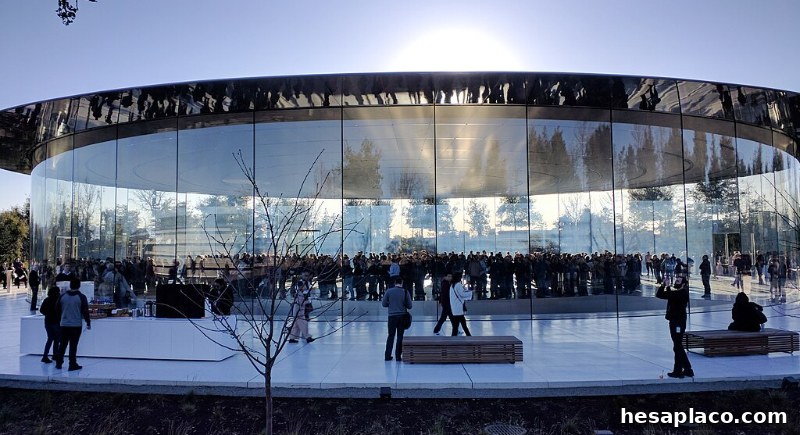
Image via Wikimedia Commons/Justin Ormont
Inside, employees describe Apple Park as visually spectacular and tightly controlled. The open-plan layout is intended to foster collaboration, but practical access between departments is often limited. Apple’s culture of secrecy means teams may work in proximity without being aware of each other’s projects, and even senior staff can be among the first to learn about new products at official announcements.
Despite the transparency of glass and broad sightlines, movement within the campus is strictly managed. Security badges monitor access, and many areas remain off-limits to all but authorized personnel.
Work life at Apple Park blends comfort with discipline. The main dining facility, referred to as The Restaurant, has four-story sliding glass doors that open onto the inner courtyard, and meals are subsidized for staff. The campus also offers a wellness center with a yoga studio, sports courts, and a juice bar. Employees receive benefits such as product discounts and fertility support, and they can even pick fresh fruit from trees grown on-site. Still, efforts to bring employees back to the office after the pandemic met resistance; many workers reported higher productivity when working remotely and questioned the need to commute to what some called a “$5 billion showcase.”
For Everyone Else
Public access ends at the Apple Park Visitor Center across the street, which includes a cafe, a retail space with exclusive merchandise, and an augmented reality model of the campus. A rooftop deck provides a framed view of The Ring through the trees, giving visitors a glimpse of the headquarters without breaching its privacy.
Beyond that vantage point, the campus remains closed to casual visitors. Behind its glass walls and landscaped mounds sits one of the most carefully designed workplaces ever built—an environment that reflects Apple’s blend of design obsession, operational precision, and guarded secrecy.