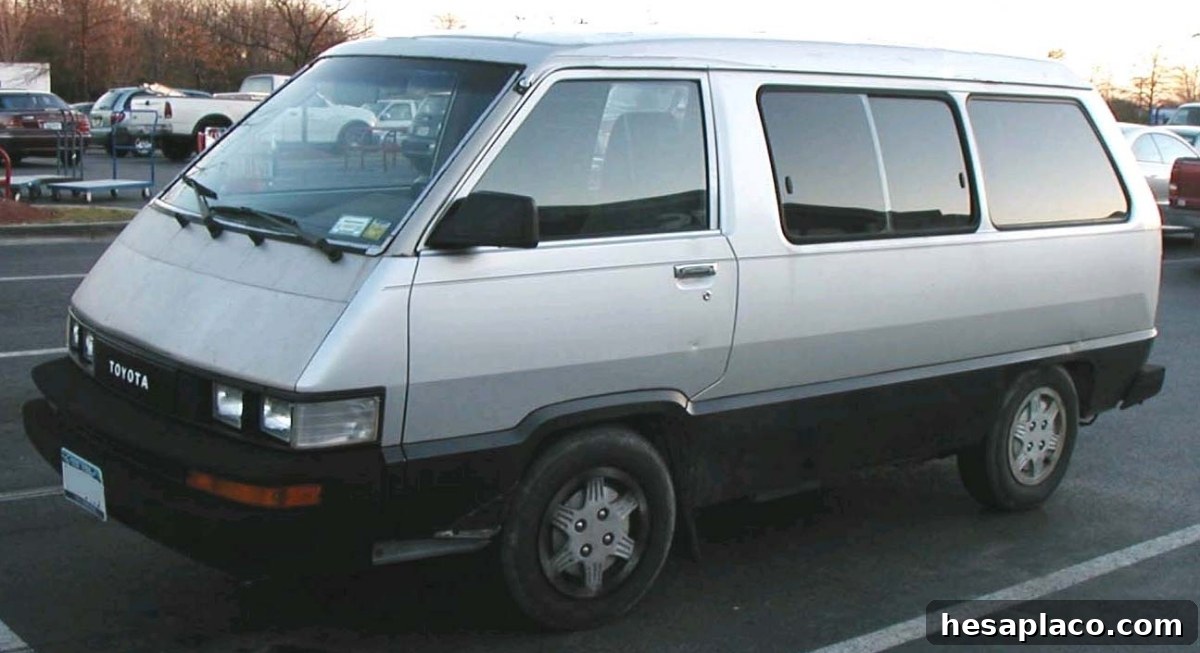
Minivans are rarely associated with innovation. They’re the cargo shorts of the automotive world: practical, dependable, and built to carry people and things without drawing attention. Occasionally, though, a minivan surprises everyone by trying to be something more. In 1984, Toyota introduced a family van that stood out not for sporty performance or flashy styling, but for an unexpectedly quirky convenience: an optional built-in ice maker.
Yes — an Actual Ice Maker in a Van
Image via Unsplash/Dylan Parton
This wasn’t a mere cooler for keeping drinks cold during a road trip. In the LE trim of Toyota’s model simply named the Van, buyers could opt for a compact, shoebox-sized ice maker that actually produced ice while the vehicle was in use. The system tapped into the same refrigerant lines used by the vehicle’s air conditioning: refrigerant was routed to a small refrigeration unit mounted in the center console. Open the compartment and you’d find spill-resistant trays designed to freeze ice cubes as you drove.
Toyota marketed the model in the United States as the Van, a straightforward name that reflected the vehicle’s utilitarian character. In Europe, however, it was sold as the Space Cruiser, a name that better matched the vehicle’s oddly forward-looking quirks — like the on-board ice maker.
The van featured a cab-over layout with the engine positioned beneath the driver’s seat; gaining access required tilting the seat forward like a trap door. It used rear-wheel drive and a 2.0-liter four-cylinder engine rated at around 90 horsepower — adequate for everyday driving but not geared toward speed or heavy loads. At roughly 170 inches long, it was compact and maneuverable, yet it still made room for unusual amenities such as the miniature freezer in the center console.
Practicality Limits Its Appeal
That said, the ice maker was more novelty than a serious, long-term convenience. Enthusiasts who discuss the model on forums such as ToyotaVanTech note several limitations: the unit produced ice slowly, occupied valuable console space, and was less efficient than later portable 12V coolers that plug into a vehicle’s power outlet. In practice, it was often more of a conversation piece than a frequently used feature.
As a result, many owners removed the factory ice maker over time to reclaim storage space or to simplify maintenance. Working original units are rare today, and those that remain are often disconnected or non-functional after decades of use.
Toyota replaced the Van with the more aerodynamic Previa in 1990, dropping the built-in icemaker. The Previa offered a simpler insulated “Hot/Cool Box” in some European markets, but the ambitious integrated freezer did not carry over. In American models, convenience features took a more conventional route: cupholders and storage compartments replaced appliance-like additions.
Why Toyota Tried It
The 1980s were a period of experimentation and bold, sometimes eccentric automotive ideas. As Toyota expanded its presence in the U.S. market, the company sought ways to differentiate its offering from domestic competitors. The Chrysler minivan, introduced just a year earlier, had captured significant attention, and Toyota responded by giving buyers a distinctive option that stood out on showroom floors.
Today, the 1984 Toyota Van enjoys a niche, almost cult-like following among collectors and retro-vehicle enthusiasts. Finding one with a factory-installed, fully functional ice maker is extremely rare — akin to spotting a unicorn at a drive-thru. Most original systems were removed, modified, or have ceased functioning, leaving the ice-making feature more a memorable oddity of automotive history than a mainstream innovation.
Ultimately, the Van’s ice maker remains a charming reminder of a time when automakers were willing to experiment with unconventional in-car amenities. It speaks to an era of bold creativity: not always practical, but frequently memorable.