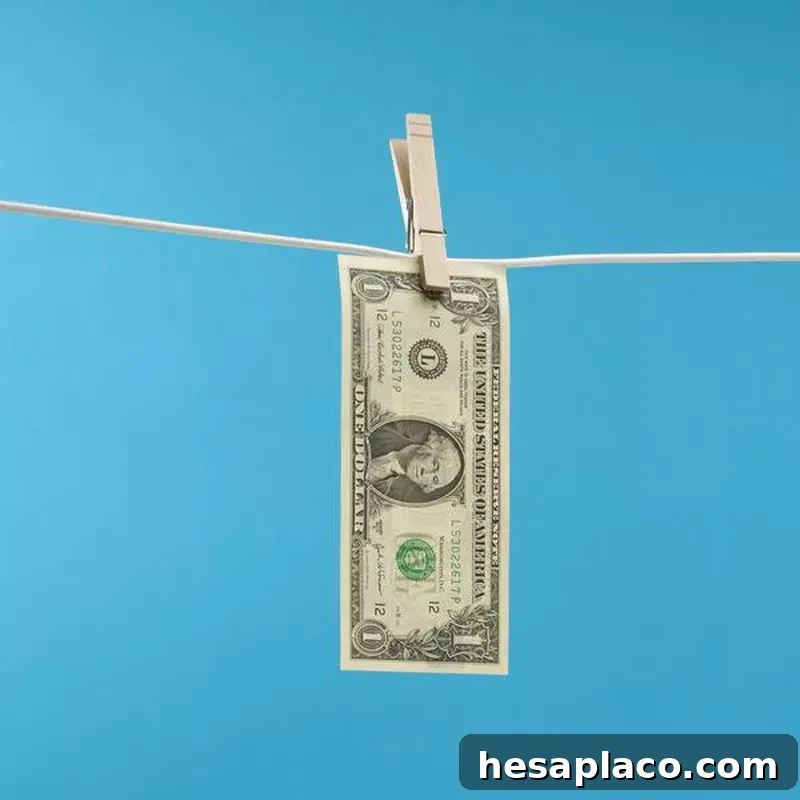
A dollar. A buck. A greenback. A single. A one. A George Washington. Whatever you call it, the U.S. one-dollar bill has a rich and intriguing history.
Given how often $1 bills change hands, it’s surprising how little many of us know about this ubiquitous note.
If you examine the one-dollar bill closely, you’ll find a detailed design filled with symbols, the Great Seal of the United States, and several Latin mottos. Those elements have inspired countless theories about hidden meanings and secret messages stamped into the bill’s imagery.
Below are 44 notable and interesting facts about the one-dollar bill that shed light on its design, production, and cultural role.
1. $1 Bills Aren’t Made of Paper
Despite being commonly called paper money, U.S. bills are actually made from a cotton-linen blend. This composition gives them a distinctive feel and greater resilience than ordinary paper.
2. $1 Bills Are Durable
The cotton and linen fibers make one-dollar bills tougher than standard paper. That durability helps them survive daily handling, folding, and frequent circulation.
3. You Can Spend Torn $1 Bills
Torn bills can still be accepted as legal tender if a sufficient portion remains intact. The Treasury has guidelines for redeeming damaged currency, and banks or the Bureau of Engraving and Printing can often redeem bills that are significantly worn or partially destroyed.
4. Almost Half of All Bills Made Are $1 Bills
Because the one-dollar bill circulates so heavily, the proportion of new notes printed tends to skew toward lower denominations. Historically, a large share of newly produced bills are $1 notes to meet everyday transactional demand.
5. How Many $1 Bills Are Made Annually?
Production numbers vary by year depending on demand and replacement needs, but the one-dollar bill consistently ranks among the most printed denominations.
6. Just How Many $1 Bills Are Out There?
There are billions of one-dollar notes in circulation worldwide. Their ubiquity reflects both American spending habits and the dollar’s widespread acceptance in international transactions.
7. The Cost of Printing $1 Bills Is Low
Because of the simple design and lack of more elaborate security features found on higher denominations, the per-note production cost for a one-dollar bill remains relatively low.
8. Why They’re Cheaper to Make
Higher denominations incorporate advanced anti-counterfeiting technologies—color-shifting ink, security threads, watermarks, and more—that raise production costs. The one-dollar bill’s design is simpler, which reduces manufacturing expense.
9. Every $1 Bill Has a Unique Serial Number
Each note carries a serial number that identifies it uniquely. That number, combined with distinctive series and plate markings, allows the Treasury to track and catalog currency.
10. The Average Lifespan of a $1 Bill
Because one-dollar bills circulate so frequently, their average lifespan is relatively short compared with higher-denomination notes. Heavy handling and everyday use result in faster wear and tear.
11. Old Bills Are Still Legal Tender
Older series of U.S. currency remain legal tender even if the design has changed. Notes issued in previous designs retain face value and can still be spent or redeemed.
12. But You’re Better Off Not Spending Old Bills
Although old notes remain legal tender, collectors may value certain older series more than face value. If you suspect a bill might be collectible, it’s worth having it evaluated before spending it.
13. The First $1 Bills Didn’t Feature George Washington
Early American currency went through many design iterations. The inaugural one-dollar notes did not always showcase George Washington; portraits and allegorical figures appeared on various early issues.
14. George Washington First Appeared on the $1 Bill In…
George Washington’s portrait eventually became the standard face on the one-dollar bill, and his image has been a defining feature of the denomination for well over a century.
15. The Portrait of George Washington on the Front of the $1 Bill Came From…
The familiar Washington portrait is based on Gilbert Stuart’s portraits, notably the Athenaeum portrait, which has long served as the model for the face of the one-dollar bill.
16. A Family Affair
Over the decades, elements of earlier designs and portraits sometimes drew from family members’ likenesses or studio variations, creating subtle connections across different issues.
17. The Design Hasn’t Changed in Over 50 Years
The basic front-and-back layout of the modern one-dollar bill has remained stable for decades. Unlike higher denominations, it has not received frequent redesigns or new security features.
18. The U.S. Government Has No Plans to Change the $1 Bill
There have been no official plans to redesign the one-dollar bill in the same way higher bills have been updated. Factors such as cost, public acceptance, and industry impacts influence that choice.
19. What’s That Date Again?
A bill’s series date reflects the year of its design or the date when a notable change was authorized, not necessarily the exact printing year. You’ll often find different series years in circulation simultaneously.
20. Lucky 13
Many elements on the one-dollar bill incorporate the number 13 as a reference to the original thirteen colonies: 13 stars, 13 arrows, and 13 leaves or other features appear in various places on the design.
21. Lucky Thirteen, Part 2
Even the Latin mottos “Annuit Coeptis” and “E Pluribus Unum” contain 13 letters each, and the Treasury seal includes 13 stars—further nods to America’s founding states.
22. Lucky 34
The reverse seal displaying 34 sides once reflected the number of states in the Union at a particular point in history. Despite the Civil War-era secessions, that design element remained, perhaps signaling confidence the Union would be restored.
23. Conspiracy Theorists Have Other Ideas
Symbols and numbers on the dollar bill have fueled many conspiracy theories over the years. While intriguing, most claims are speculative interpretations of historical design choices.
24. About the Great Seal
The Great Seal’s two-sided imagery—the pyramid with an eye on the reverse and the eagle on the obverse—reflects different symbolic intentions chosen by the seal’s designers and committees early in the Republic.
25. War and Peace
The eagle on the obverse of the Great Seal holds both an olive branch and arrows. Those elements symbolize the nation’s dual posture: a preference for peace accompanied by readiness for war when necessary.
26. The Olive Branch and the Arrows in the Eagle’s Claws Used to Be Reversed
Design variations over time included different arrangements of the eagle’s talons. The final choice placed the olive branch in the eagle’s right talon and the arrows in the left to emphasize peace first.
27. Is It a Bird?
The stylized eagle on the seal has prompted debate and misidentifications, but it’s intended to represent the American bald eagle, an emblem chosen for its strength and symbolism.
28. Again, Conspiracy Theorists Have Other Ideas
Because the seal contains many symbolic elements, some observers have proposed alternate or hidden meanings. Historians and archivists generally attribute these elements to deliberate, documented symbolism rather than secret codes.
29. It’s Latin to Me
The bill includes Latin phrases such as “Annuit Coeptis” and “E Pluribus Unum,” both of which were chosen for their classical resonance and connection to the nation’s founding principles.
30. The Meaning of the Phrases
“E Pluribus Unum” translates roughly as “Out of many, one,” reflecting unity among the original states. “Annuit Coeptis” is often rendered as “He (Providence) has favored our undertakings,” a phrase expressing hope for divine approval of the nation’s efforts.
31. The Vending Machine Industry Doesn’t Want the $1 Bill Changed
The vending and automated-tender industries have cited the high costs of adapting machines to new bill designs as a major reason to resist changes to the one-dollar bill. Reconfiguring or replacing bill validators can be expensive at scale.
32. Vending Machines, Continued
In the early 2000s, concerns about the financial burden on vending operators influenced the decision to delay or block a potential redesign. Policymakers weighed industry impacts alongside counterfeiting and security considerations.
33. Some People Do Want the $1 Bill to Go Away
From time to time, lawmakers and commentators have proposed replacing the one-dollar bill with a coin to save long-term production costs. A 2012 bipartisan proposal to replace the bill with a dollar coin did not pass.
34. It’s the Only Bill That Gets Tested
The one-dollar bill has sometimes been used in experimental printing processes. Certain short-run experimental presses produced notes in limited series; these distinct issues can be rare and sought after by collectors.
35. Never Put Your Money Where Your Mouth Is
As an aside about hygiene and practicality, people are advised not to store cash in their mouths or other unsanitary places—currency circulates widely and can carry germs.
36. You Can Track Your Bills
There are community websites and projects that let people log serial numbers and track the movement of bills they’ve entered into the system. Enthusiasts enjoy seeing how far a note travels over time.
37. ‘In God We Trust’ Is Law
The phrase “In God We Trust” appears on U.S. currency by statute. It serves as the nation’s official motto and is printed on all current denominations.
38. ‘In God We Trust’ First Appeared on Paper Money in 1957
While the motto was added to various coins earlier, it first appeared on paper currency in 1957 and has been included on bills since then.
39. The Seal of the Department of the Treasury Appears on Every $1 Note
The Treasury seal is a standard feature on one-dollar bills and denotes the department responsible for issuing and managing federal currency.
40. Before 1996, U.S. Bills Featured the Seal of the Individual Federal Reserve Bank Where They Were Made
Earlier notes carried identifiers linking them to specific Federal Reserve Banks. After changes in design and consolidation of federal features, that practice was discontinued.
41. The First $1 Bills Issued With George Washington’s Face Didn’t Show the Great Seal
Initial issues that began using Washington’s portrait did not always include the modern Great Seal elements on the reverse. The bill’s imagery evolved through a series of redesigns to reach the present composition.
42. Benjamin Franklin and Thomas Jefferson Wanted an Egyptian Pharaoh on the Great Seal
During early deliberations about national symbols, a range of creative and eclectic proposals surfaced. Some founding figures suggested classical or exotic motifs, reflecting the era’s fascination with antiquity and symbolism.
43. They Also Wanted to Put the Motto ‘Rebellion To Tyrants Is Obedience To God’ on the Great Seal
Various strong motto proposals were debated in the seal’s early design process. Ultimately, the creators adopted different phrasing and symbolism that emphasized unity and providential favor.
44. How Long Would $10 Billion $1 Bills Last You?
Ten billion one-dollar bills would be an immense physical and monetary quantity—enough to illustrate the scale of currency circulation and how quickly lower-denomination notes can accumulate when counted in large totals.